God is [not] Safe

Podcast version available on Apple Podcasts, Spotify, and Anchor!

When I was growing up, my parents introduced my brothers and me to The Chronicles of Narnia. I remember us piled on their bed while Dad read to us from these classic books of fantastical adventure. He took the time to explain the deeper connections the author, C.S Lewis, was making between the enchanted world in the woods to Jesus, to humanity, and to God’s character.

There’s a line from the series’ most popular book, The Lion, The Witch, and The Wardrobe, that is meant to make a definitive statement about God Himself, and truth be told, I never understood it.

In the context of the story, the four children are asking a wise, older couple (who happen to be talking beavers, but that’s neither here nor there!) about Aslan, the Lion, the hero of the story. The children ask Mr and Mrs Beaver if Aslan is safe.

Mr Beaver responds:

Safe? Who said anything about safe? ‘Course He isn’t safe. But He’s good. He’s the King.

– C. S. Lewis; The Lion, The Witch, and The Wardrobe

For all the affection I had for the world C.S. Lewis created in the enchanted woods of wintry Narnia, that line was so puzzling to me.

For one, I knew enough to know that the mighty Aslan represented God in these stories. So how could God not be safe? On top of that, if we’re saying He isn’t safe, then ‘good’ couldn’t possibly be the alternative! I could think of a dozen adjectives that were far better than ‘good’. Good was lame. Good seemed so boring to me. Good was the answer to questions you couldn’t be bothered with, like:

How was school?
-Good.

How’s dinner?
– Good.

How was the doctor’s appointment
– Good.

How’d you sleep?
– Good.

How are you?
– Good.

I mean, no thank you! A God that’s just ‘good’ doesn’t seem worth my time. Much less my surrender and sacrifice.

If He’s not safe, then give me powerful! Give me amazing! Give me brilliant! Or compelling! Or omniscient! Or really any other omni-word that applies to Him alone. I’ll take it. But good? Good is lacking. C.S. Lewis could have done better there.

Unless… unless we explore what God’s goodness really means in light of His holiness.

God’s holiness means that He cannot be in the presence of sin. We’re shown this clearly in Leviticus 10, when the sons of Aaron the priest offered unauthorized fire before the Lord, contrary to His command. They had no regard for the parameters God had established in order to provide a way for His people to actually draw near to Him safely. As a result, fire came out from the presence of the Lord and consumed them, and they died on the spot.
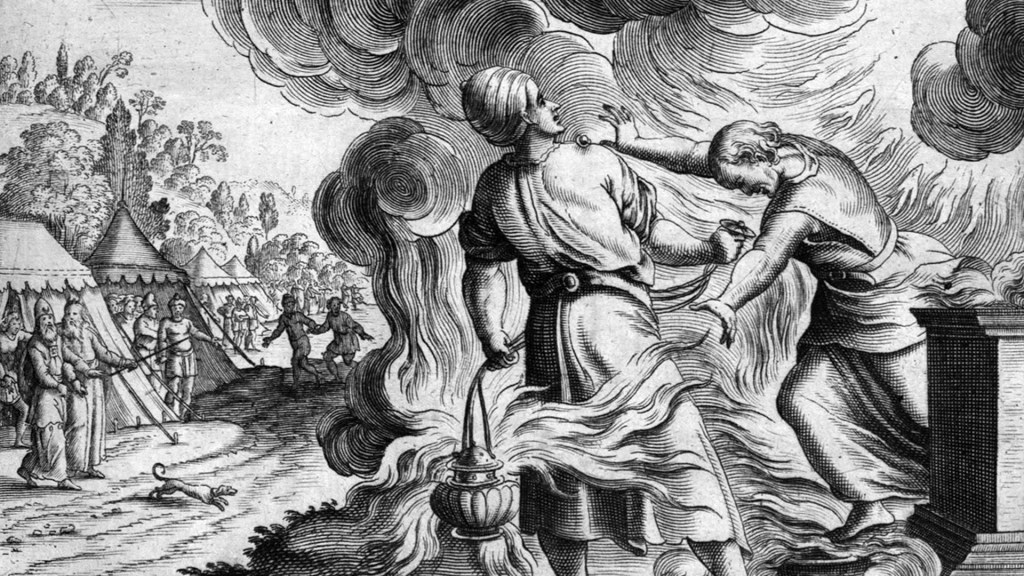
Another example is in 2 Samuel 6, when King David was having the Ark of the Covenant brought back to Jerusalem in a long processional celebration. While on their way, the oxen carrying the Ark slipped, and it started to topple over. In that moment, a man named Uzzah, who was guiding the Ark, reached out to steady it. The Scriptures say that the Lord’s anger burned against Uzzah because of his irreverent act. God struck him down, and he died right there beside the Ark of God.

One more example, and it’s a beautiful one

Thankfully, it’s not so shockingly traumatic, so stay with me!

In Exodus 33, Moses is having it out with God. God tells Moses that the Israelites could continue on to the Promised Land, but that He wouldn’t be going with them because they were a stiff-necked people and He might just destroy them on the way.

This means, that for their protection, God is saying that in their sinful state, they are not safe in His Holy Presence. But Moses pleads with God, and tells Him that he doesn’t want God’s blessings without God Himself.

That’s because Moses recognized what so many people – Christians included! – do not: what even is blessing apart from God?

Moses said it this way,

If Your Presence does not go with us, do not send us up from here. 16 How will anyone know that you are pleased with me and with your people unless You go with us? What else will distinguish me and Your people from all the other people on the face of the earth?

Exodus 33:15-16

Moses recognized what can easily be missed. There is no goodness apart from God. There is no blessing, prosperity, peace, or flourishing without Him.

In response to Moses’ plea, God relents and agrees to go with them to the Promised Land. But not before Moses makes another bold request of God.

Moses asks God,

“Show me Your glory”

God tells Moses that no one can see the Lord and live. But God does arrange for Moses to see His back as His glory passes by him. God actually calls it His goodness!

He says to Moses,

I will cause all My goodness to pass in front of you, and I will proclaim My Name, the Lord, in your presence. I will have mercy on whom I will have mercy, and I will have compassion on whom I will have compassion.

– Exodus 33:19

A beautiful story, right? But does this mean He is safe? The point of all these stories is this: God is holy. God is a consuming fire. When we get too close, we are not safe. He is too holy for a sinful people to survive His presence.

BUT! He is good. And in His goodness, He made a way for us to draw near to Him without being completely destroyed by His very Presence.

And that’s Jesus.

Through Jesus, we can draw near to God in good times, in bad, in strife, in pain, in sin, in suffering, in all our mess.

Isaiah 53:3 talks about how in Jesus’ death, He became so acquainted with sin and pain, more intimate with them than any human ever could. So that He could conquer them on our behalf. His resurrection is proof that sin and death were defeated. This means we could now draw near to God in our own pain.

Is He safe? ‘Course He isn’t safe. But He’s good. He’s the King.

  • So even when the struggles of life rage on around us, we can draw close to God, through Jesus who made that possible.
  • Even when we’ve soiled our hands with the dirtiest of sin, we can draw close to God, because He is good.

Seeing God’s greatness is not our deepest need, but seeing His goodness.

– Dane C. Ortlund

What really draws us to God is not the flashy miracle or mighty acts – as spectacular as they are.

His greatness isn’t what draws us. It’s His goodness! The fact that we can draw near to Him in our pain. It’s the beauty of knowing that even in His holiness, He draws near to us in our struggle.

Is there greater comfort than that?

As Moses asked of God,

How will anyone know that we belong to You, if You do not go with us?

– Exodus 33:16

Taste and see that the Lord is good. Blessed are those who take refuge in Him.

– Psalm 34:8

Do YOU want real blessing? You can find it by taking refuge in God through the storms of life or even because of the consequences of your own sin. Taste and see how good He is through it all. Just by choosing to be in His presence.

What’s in the Ears

Y’all, this song. I’ve loved it for years and then forgot about it. But it hit my radar again recently and it’s just so good. Enjoy!

Has this helped you to see how good our God really is? Let me know in the comments or send me a message!

Podcast version available on Apple Podcasts, Spotify, and Anchor!

Lent Remix

Podcast version available on Apple Podcasts, Spotify, and Anchor!

Let’s talk Lent. For many, it’s about cutting sugar, coffee, or Instagram. It’s about drinks on Mardi Gras and trying real hard to feel real bad about all that cussing that can’t seem to be stopped.

For me, the disciplines of fasting and Lent were not prominent parts of my faith tradition growing up.

I had only ever fasted as part of the 30 Hour Famine as a teenager, and admittedly, I cheated every time. As for Lent, I engaged in the traditions in my recent past, and did not find it particularly meaningful. Probably because my heart just wasn’t in it.

Leading up to this season of Lent, it has occurred to me that God is not a god of subtraction, reduction, decrease, or want in general.

In the Amplified translation of John 10:10, Jesus says:

The thief comes only in order to steal and kill and destroy. I came that they may have and enjoy life, and have it in abundance [to the full, till it overflows].

And this led me to an epiphany…

Lent isn’t only about what you give up through self-denial and sacrifice.

Lent is also about intentionally inviting more of God into your life as you prepare to celebrate Jesus’ death and resurrection at the end of the Lenten period, culminating with Easter.

Disclaimer: If the Holy Spirit is nudging you to give up something for Lent, I promise, you won’t get much out of Lent by disobeying that call. Doing what God asks of you is ALWAYS the right thing to do.

The prophet Samuel reminds us:

What pleases the Lord more? Burnt offerings and sacrifices, or obeying the Lord? It is better to obey than to offer a sacrifice. It is better to do what He says than to offer the fat of rams.

– 1 Samuel 15:22

With this in mind, I’ve prayerfully decided to do a Lent-in-Reverse. Rather than give something up for Lent, I will add something instead. Because although giving up something for Lent is a good thing, it’s meaningless if you’re not intentionally putting the things of God in their place.

And I invite you to join me as the Lord leads you!

What has been impressed on my heart is to memorizing Scripture.

Here’s some background on how I got here:

I’ve been especially struck by the humility of Jesus. In the Gospels, Jesus is repeatedly confronted by religious leaders who felt threatened by Him and I’m inspired by how He either keeps His cool when responding, or simply doesn’t respond at all.

Furthermore, I am so moved by the description of Jesus in Philippians 2. Paul talks about our mindsets reflecting that of Jesus’ obedience and humility as He prepared to be crucified.

Humble obedience is hugely lacking in our world today – whether you profess the name of Jesus or not! The bottom line is that we want to do what we want to do and pride isn’t going to let anyone tell us differently.

Jesus wasn’t like that. And I want to be more like Him.

Therefore, for the 40 day Lent period, I plan to carve out time to memorize Philippians 2:1-18.

If this interests you, will you join me?

Here’s some inspo to pump us up!

I adopted this phrase from podcast host, Annie F. Downs, who says:

More than I want food, I want You [God].

– Annie F. Downs

The idea is to give something up in order to get more of God. So when I’m fasting and feeling sluggish or tempted to break my fast, I pray that aloud…

More than I want food, I want You.

When I’m in a disagreement, or when my children are non-compliant, or when I feel misunderstood, I pray aloud…
More than I want to be right, I want You.

When I’m tempted to spend money on something frivolous, I remind myself to pray aloud…
More than I want to blow my money on this, I want You.

Similarly, when it’s easier to vegg in front of the TV or scroll on my phone during Lent, I hope that I will recognize and pray aloud…
More than I want to numb my brain, I want You.

The ultimate goal is to gaze upwards

Another way I would describe this Lent-in-Reverse is to gaze up, rather than down. When we look down towards our own sin, shame, and all the things we may struggle to give up whilst fasting, we can feel deflated, irritable, or morose.

Simply put, we’re focusing on the wrong thing.

And although there is a place for this as we reflect and repent, it is especially meaningful and impactful to gaze upwards at Jesus. Focus on His sacrifice, His holiness, His mercy, grace, forgiveness, love, and compassion. Be overwhelmed by Him!

So as we meditate to the point of memorizing Scripture, my hope is that this discipline will cause us to more fully appreciate Jesus’ sacrifice and the salvation He bought for us on the cross.

Maybe, just maybe, Easter will be more profound, more awe-inspiring, and more gratitude-provoking after 40 days of more of Him.

We’ll close with Philippians 2:1-18 in the NIV.

Therefore if you have any encouragement from being united with Christ, if any comfort from His love, if any common sharing in the Spirit, if any tenderness and compassion, then make my joy complete by being like-minded, having the same love, being one in spirit and of one mind. Do nothing out of selfish ambition or vain conceit. Rather, in humility value others above yourselves, not looking to your own interests but each of you to the interests of the others.
In your relationships with one another, have the same mindset as Christ Jesus:
Who, being in very nature God, did not consider equality with God something to be used to His own advantage;
rather, He made Himself nothing by taking the very nature of a servant, being made in human likeness.
And being found in appearance as a man, He humbled himself by becoming obedient to death– even death on a cross!
Therefore God exalted Him to the highest place and gave Him the name that is above every name,
10 that at the name of Jesus every knee should bow, in heaven and on earth and under the earth,
11 and every tongue acknowledge that Jesus Christ is Lord, to the glory of God the Father.
12 Therefore, my dear friends, as you have always obeyed—not only in my presence, but now much more in my absence—continue to work out your salvation with fear and trembling, 13 for it is God who works in you to will and to act in order to fulfill His good purpose.
14 Do everything without grumbling or arguing, 15 so that you may become blameless and pure, “children of God without fault in a warped and crooked generation.” Then you will shine among them like stars in the sky 16 as you hold firmly to the Word of Life. And then I will be able to boast on the day of Christ that I did not run or labor in vain. 17 But even if I am being poured out like a drink offering on the sacrifice and service coming from your faith, I am glad and rejoice with all of you. 18 So you too should be glad and rejoice with me.

What’s in the Ears

So, are you with me?! If you prefer to memorize a smaller portion of the passage or a different passage altogether, feel free! Memorizing together is so fun and I’d love to know if you decide to join me – so send me a message or comment here if you do!

Podcast version available on Apple Podcasts, Spotify, and Anchor!